Empyreal Light
Mythological and Scientific Explanation for the Polar Lights Across History
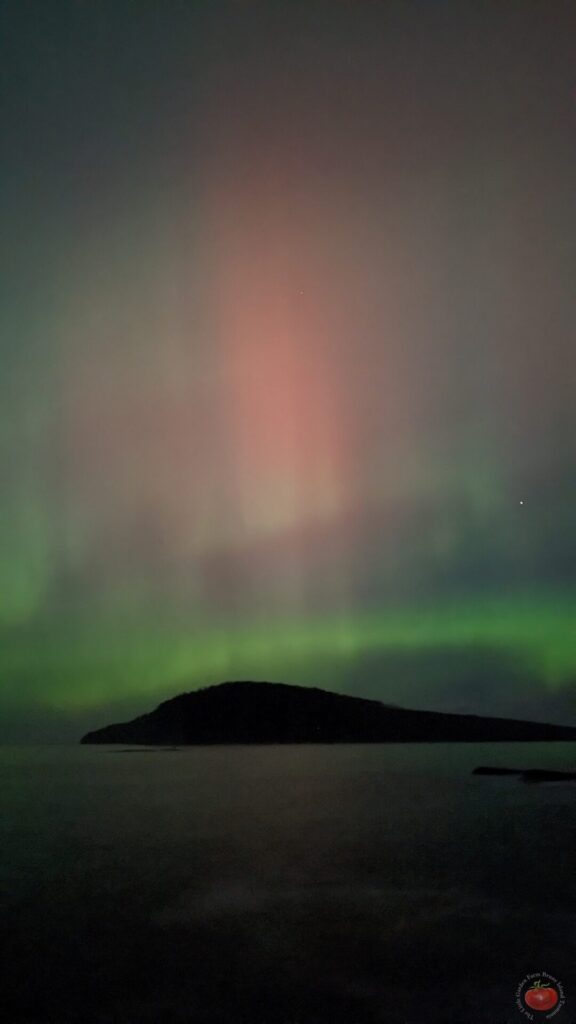
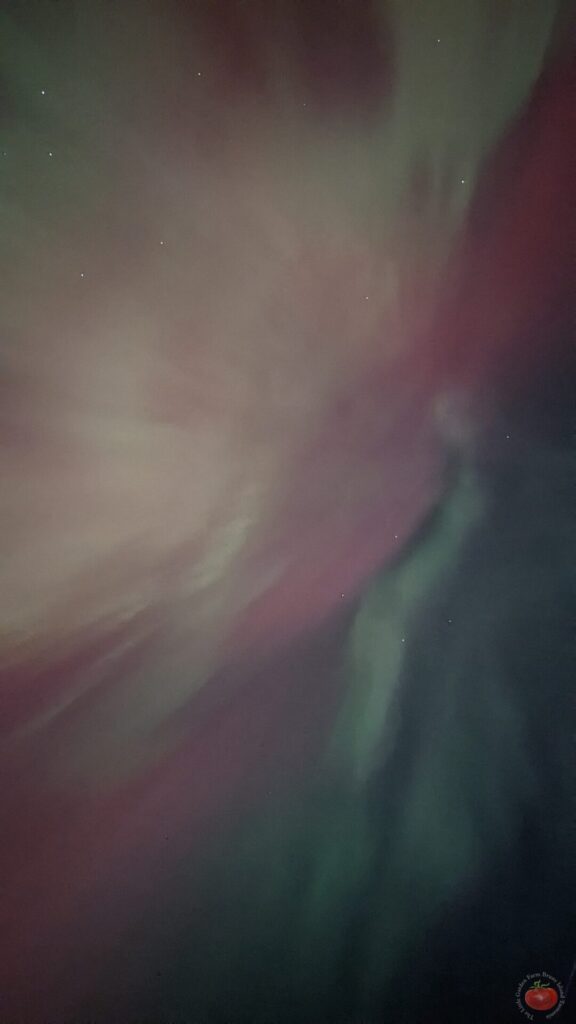
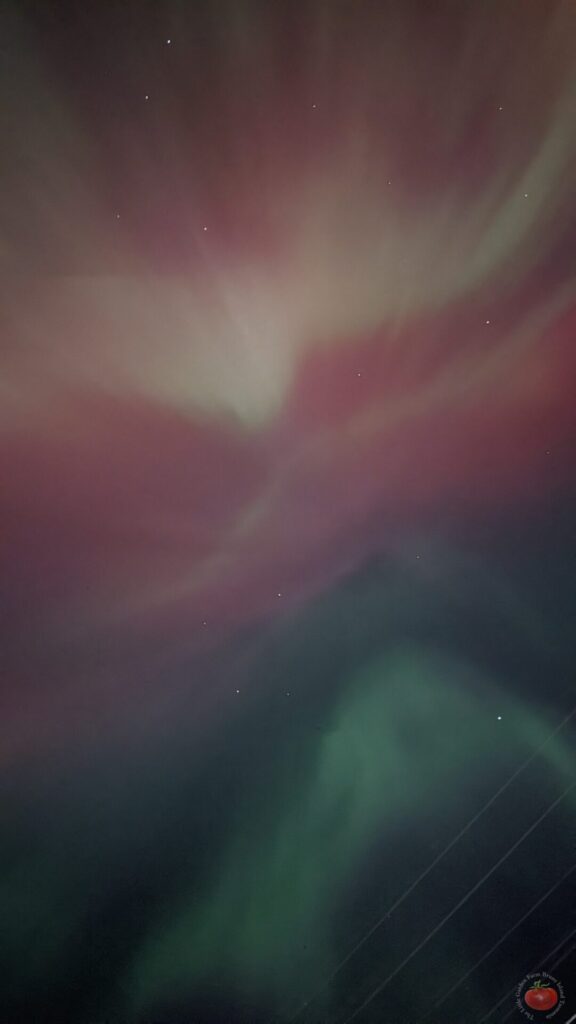
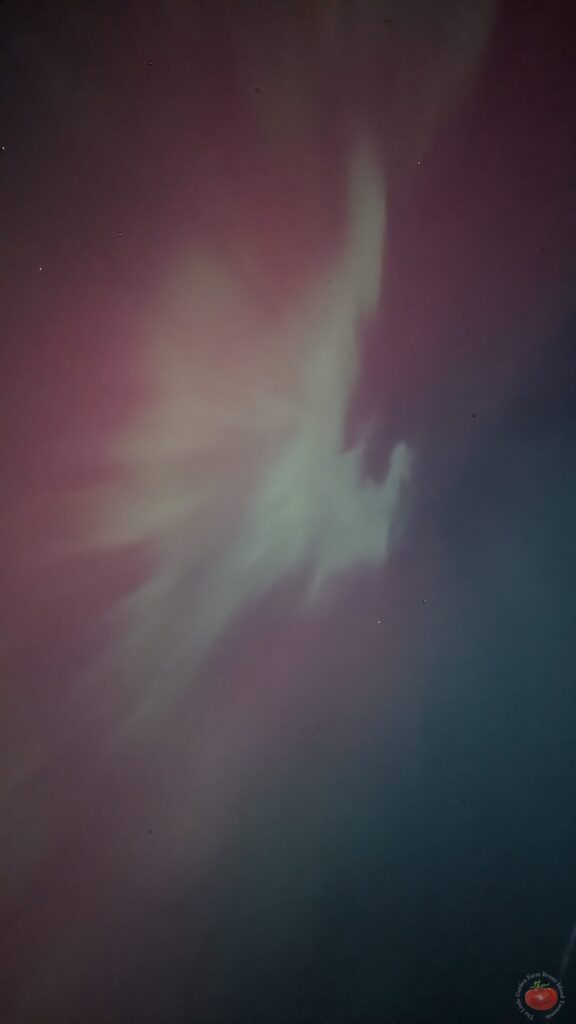
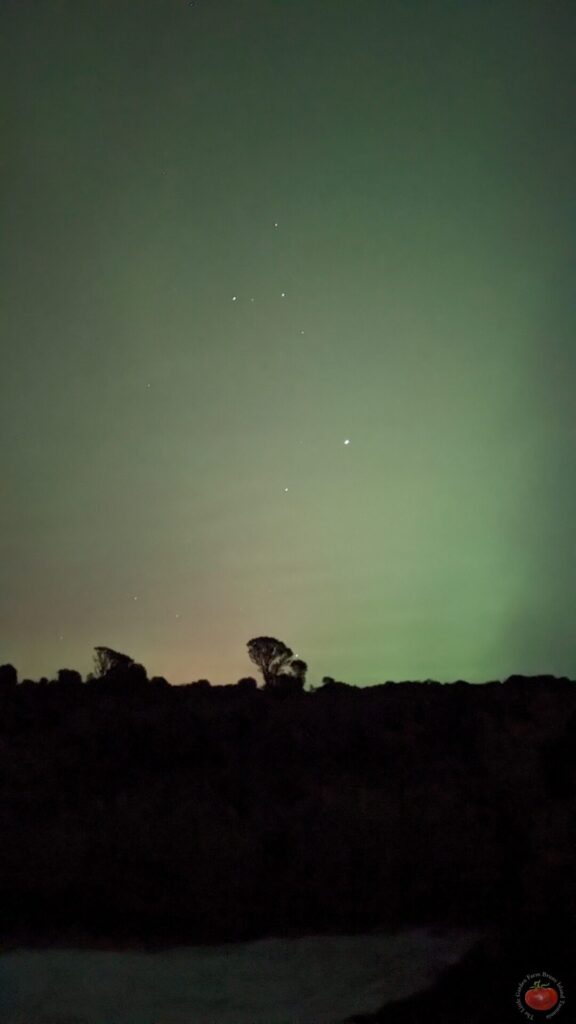
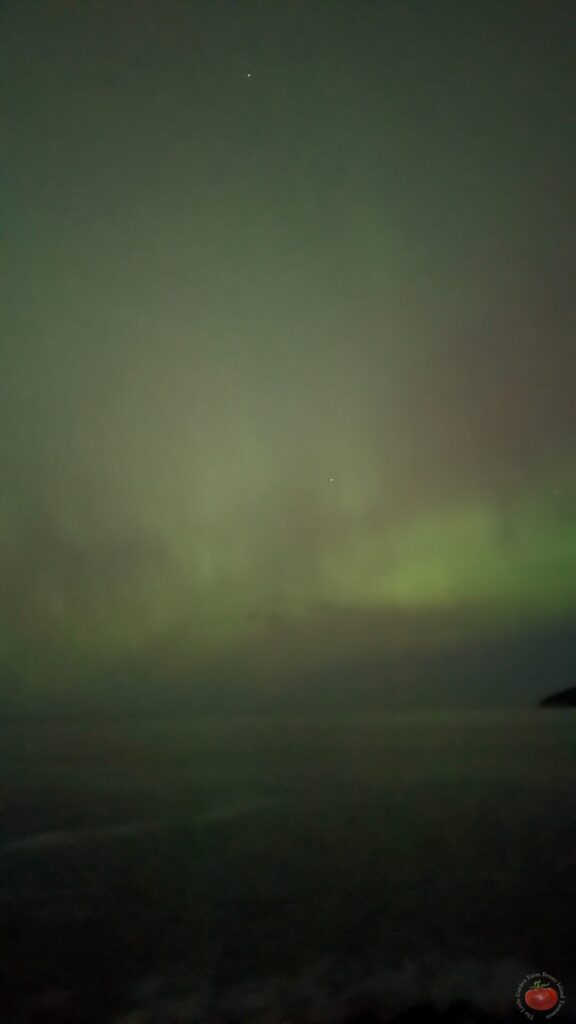
Published By The Little Garden Farm Bruny Island Tasmania 4-4-2026 Photos by the Author
Few phenomena have such power as the aurora in drawing gazes heavenwards. These lights which ripple and shimmer phantasmagoric patterns across our night sky have enthralled and bewildered all throughout human history. In the most varied ways they have quickened our imagination and sparked our curiosity.
***
The southern lights, as observed from Australia, most commonly exhibit red hues. This has, understandably, fostered associations with fire1. In Aboriginal traditions, an aurora could signify a bushfire in the spirit world, campfires in the land of the dead, or a conflagration lit by an evil spirit2.
Not all who looked saw fire, though: for the Wiimbaio people auroras were omens of disease, for the Gunai people they were the physical manifestation of godly anger, and for many Aboriginal people across southern Australia they represented the blood of embattled warriors (here, too, the redness of the local auroras is noteworthy)3.
***
These themes of fire, premonitory omens, and other frightful things also appear elsewhere. Seneca wrote in the Naturales Quaestiones of the ‘Bright gleams of light which the Greeks call Sela (luminosities)’, explaining that ‘No one has any doubt that these burnings in the heavens contain flame as really as they display it: they have a certain substance in them’4. Seneca also recorded here a case in which a fire brigade, falsely believing a dull glow in the sky (an aurora) to be the result of flames, hurried to rescue the supposedly endangered colony at Ostia5.
On 16 May 1921 a remarkably similar account appeared in The Mercury, relating how there had been between 6 and 7 o’clock the previous night an auroral display so brilliant that an alarm of fire had been sent to the Hobart fire brigade6. Apparently, a resident of South Hobart had misread the aurora australis as the ‘reflection of a big fire’7. The article reports: ‘The firemen realised the futility of attempting to douse the southern lights with an application of Hobart’s much – discussed water supply, and had no alternative but to return to headquarters’8. From antiquity to the modern age, evidently, auroras have incited panic.
***
Fear of the auroras was in some cultures especially prevalent. Among the Sámi people of northern Europe the lights were typically considered to be the souls of the dead; and it was believed that to draw in any way the attention of these dead souls – e.g. by waving or singing – was dangerous9. Of some Alaskan Inuit communities it is said that their fear of the northern lights in fact led them to carry knives for protection10.
It was not fear, however, that the Inuit of the Hudson Strait in the far north of Quebec felt when they beheld the polar lights. They understood auroras to be the torches of spirits guiding the souls of the deceased into paradise11. And so a sighting of an aurora was to them a welcome and heartening experience.
These mythologies surrounding the aurora – irrespective of whether the lights are treated as a positive or negative event – interweave the natural world with the personal and cultural lives of observers. Yet in the seventeenth century the aurora began increasingly to be regarded within a rational, scientific framework. Supernatural explanations sufficed no longer, and new theories abounded, attempting through careful observation and consideration to discern the true cause of the polar lights.
***
In Discorso delle comete, Galileo theorised that auroras were induced through the reflection of sunlight off ‘vaporous air’ rising above Earth’s shadow cone12. Similarly, René Descartes believed the auroras – along with rainbows and parhelia – to be produced via the sun illuminating clouds or vapours13. Jean-Jaqque Dortous de Mairan’s theory proposed that the auroral glow originated in the mingling of vapours with rarefied air14.
Benjamin Franklin, however, presented in 1778 a hypothesis altogether different from those involving clouds, vapours, and sun-illumination. That it had instead to do with electricity, though, is perhaps unsurprising. Franklin conjectured that the electricity present in precipitation – snow, in this case – would accumulate on the polar ice, which served as an insulator preventing electrical discharge back into the earth15. Because of this, he supposed, the electricity might instead find escape by breaking through the lower atmosphere to the thinner air – the vacuum – above, which, he pointed out, was a good conductor16. The electricity then would run along the upper atmosphere until it found a point of passage back to earth and, in doing so, produce the mosaics of light we know as the aurora17.
***
Franklin’s hypothesis was an interesting new approach to explaining the origin of auroras, but it was to be over a century later that the theory foundational to modern understanding was established. The Norwegian scientist, Kristian Birkeland, commenced in 1899 the first of a series of arctic expeditions carried out in order to study the aurora borealis18. It was a bold undertaking, and the brutal conditions resulted in the death of two of Birkeland’s companions; but the research proved a connection between the northern lights and polar electromagnetic currents19.
Birkeland published his theory explaining how electrons emitted from the sun are guided to the poles by Earth’s magnetic field and generate there auroras20. But it was met with resistance. Many physicists dismissed the theory, and Birkeland did not receive proper recognition for much of his research until after his death21. Nonetheless the nature of the polar lights is indeed largely what he claimed it to be.
***
Charged particles and magnetic fields are continually ejected from the sun – this is known as solar wind22. Because the Earth has its magnetosphere, the solar wind does not collide directly with the planet. Instead, it flows around the magnetosphere like river-water around a rock23. As it rushes along the magnetic field lines, the wind draws nearest the planet at the poles24. If it manages to reach the Earth’s atmosphere it interacts with oxygen and nitrogen atoms there, exciting them25. The atoms in this excited state have more energy, and when they release this energy, as they must in order to return to their ground state, light is emitted26.
The colour of the light produced is dependent on the composition and the altitude27.

***
The unknown is an emptiness – one which we, per human nature, tirelessly endeavour to fill in. And what we fill it with varies exceedingly. A phenomenon such as the polar lights thus will accumulate myriads of legends, myths, and theories as we seek to answer the question of its existence. Yet as ever more evidence is brought to light, the possible explanations are ever further constricted until, ultimately, only one is reasonable. And so the mystery is gone. These prior attempts at explanation, however, are not forgotten; for many they are undiminished in importance, matters of pride or cultural identity; and to all they tell the story of humans unrelenting in their struggle to understand the cosmos.
References
1 Duane W. Hamacher, “Aurorae in Australian Aboriginal Traditions”, Journal of Astronomical History & Heritage 17(1), (2014), 8.
2 Ibid.
3 Ibid, 8, 10.
4 Seneca, Physical science in the time of Nero, trans. by John Clarke, (London: Macmillan and Co, 1910), 39-41.
5 Ibid, 40-41.
6 “The Aurora Australis”, The Mercury, May 16, 1921. http://nla.gov.au/nla.news-article23469362
7 Ibid.
8 Ibid.
9 Asgeir Brekke, Alv Egeland, The Northern Light: From Mythology to Space Research, (Springer-Verlag Berlin Heidelberg, 1983), 4; Anadi Purewal-Legha, “Aurora Borealis — not bore-alis! The Northern Lights Ancient Legends and Scientific Wonders”, The Synapse: Intercollegiate science magazine 38(1), (2023).
10 Anadi Purewal-Legha, “Aurora Borealis — not bore-alis! The Northern Lights Ancient Legends and Scientific Wonders”, The Synapse: Intercollegiate science magazine 38(1), (2023).
11 Ibid.
12 Mauro Gargano, Emilia Olostro Cirella, Clementina Sasso, “When the North Shines in the South”, Paesaggi del rischio, (Federico II University Press, 2026), 169.
13 Ibid.
14 Ibid.
15 Benjamin Franklin, “Suppositions and Conjectures on the Aurora Borealis”, [before 7 December 1778], Founders Online, National Archives, https://founders.archives.gov/documents/Franklin/01-28-02-0150. [Original Source: The Papers of Benjamin Franklin, vol. 28, November 1, 1778, through February 28, 1779, ed. Barbara B. Oberg, (New Haven and London: Yale University Press, 1990), 190–200.]
16 Ibid.
17 Ibid.
18 Abigail Eisenstadt, “Death of Kristian Birkeland, King of the Northern Lights”, APS, (2022), https://www.aps.org/apsnews/2022/06/death-birkeland-northern-lights
19 Ibid.
20 Dr. William B. Ashworth Jr., “Kristian Birkeland”, Linda Hall Library, (2019), https://www.lindahall.org/about/news/scientist-of-the-day/kristian-birkeland
21 Ibid.
22 “Auroras”, NASA Science, accessed March 26, 2026, https://science.nasa.gov/sun/auroras/
23 Ibid.
24 Ibid.
25 Ibid.
26 Ibid.
27 Ibid